A PRIMER ON KNIFE SHARPENING - Chapter 3
Steve Bottorff
photographs by Carol Butz
CONTENTS
THE SHARPENING
PROCESS
Recommended
Books on Knife Sharpening
THE
SHARPENING PROCESS
THE
COMMON MISTAKES
The mistakes commonly made in
sharpening are uncontrolled edge angles, failure to establish a new edge,
and leaving the edge too rough. The following methods address each of
these mistakes.
The keys to success are:
1) Use an angle guide to control the
edge angle,
2) Sharpen until you raise a burr,
and
3) Hone or polish the edge smooth.
Some instructions refer to the
sharpening motion as trying to slice a thin layer or a decal off the
stone. This is bad advice, and here's why: most people won't hold a
constant angle this way. Every different edge requires that you hold the
blade at a different angle when slicing a thin layer. You instinctively
raise the blade until you detect the edge working. This is almost a sixth
sense, involving both feeling and hearing. The same thing happens when
sharpening by hand. The duller the blade becomes the more you raise it
more before you can sense the edge working against the stone. This creates
larger edge angles as time goes on and the results gradually deteriorate.
Skill and practice will overcome this problem, but the sure-fire way is to
use a guide to maintain edge angle.
If you do not remove enough metal to
create a new edge, you will leave some of the dull edge in place. The
easiest way to determine that you have removed enough metal is to grind
until you have raised a burr. Steel will naturally form a burr when one
bevel is ground until it meets another. You can then remove the burr in
the honing process and have a sharp edge every time.
A final honing and polishing will
bring the edge to perfection.
THE
CONVENTIONAL METHOD
For fast removal of the old edge,
start with a coarse, fast cutting stone. Diamond stones are the fastest
cutting manual stones, with Japanese waterstones second. The first step is
where most of the work is, and you can benefit most from using a power
sharpener.
Set the guide and take a light stroke
with the stone. Check the angle against the old bevel. If the new scratch
pattern is on the back edge of the old bevel, you are lowering the angle.
If it is at the edge, the angle is being increased. When the scratch
pattern is centered on the bevel you are duplicating the original angle.
Keeping the original angle is a safe strategy until you gain more
knowledge.

Black marker helps show the honing angle, here with a rod-guided
system.
If you can't see the scratch pattern,
try darkening the old bevel with a black felt tip marker, then stroke the
stone again. The scratch pattern will stand out against the dark marking.
When the angle is set correctly,
grind one side of the blade until you have removed the old edge. Grind
until you have raised a burr. The burr will appear on the side opposite
the one you are grinding. With experience you will learn how to stop with
just a small burr in this step. If you are not sure, grind until you can
feel the burr. Then turn the blade over and grind an equal amount off the
second side.
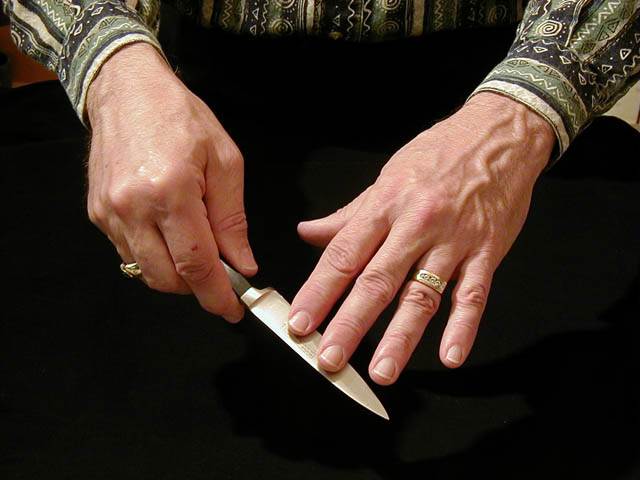 Feeling the burr.
A burr is a natural occurrence in
steel when one bevel is ground until it meets another. When I was learning
I would show my work to my grandfather, and he would often show me that I
had a burr. It seemed sharp, but the burr would eventually bend over and
become dull. I tried to avoid ever raising a burr for years after that. As
a result I never got anything quite sharp. Now I know that one of the
secrets of sharpening is to raise a burr, then hone it away.
Ceramic knives and some very hard
steel will not raise a burr. Here again experience will tell you when you
have ground enough.
There are three basic strokes when
you sharpen - sliding the stone onto the edge, sliding it off the edge, or
circular strokes. At the first stage, any of the three is okay, although
sliding the stone off the edge makes a larger burr, which in turn makes it
easier to detect.
For the next step use a medium stone.
Its purpose is not so much to remove material as to grind away the
scratches made by the first stone. The medium stone should be about twice
as fine as the first. If you started with a 180 grit stone, you can use
320 or 360 now. Use circular strokes until the old scratch pattern is
gone. Then do an equal amount of grinding on the second side.
You might still be able to
detect a small burr at this stage. Finish with a few light strokes sliding
onto the edge to remove the burr. This is where slicing a decal off the
stone is an accurate description. The blade should now be sharp with no
burr. The edge now has 320 or 360 grit micro-serrations, which is good
enough for many uses.
The micro-serrations are providing
some of the apparent sharpness now but they will wear and bend. A steel or
a touch-up stone will straighten them and bring back the sharpness.
Continue to the next step if you want a longer lasting edge.
For the third step use a fine stone,
600 or 800 grit, and hone using only strokes going onto the edge.
Alternate sides with every stroke. This will help prevent forming a
new burr.
Your edge should now shave. Test it
as described above. If there is roughness, go back to the medium stone. If
there is no roughness but the edge doesn't have enough bite, continue with
the fine stone.
When the blade becomes dull, repeat
the medium and fine stones. Only when the blade becomes nicked or damaged
will you need to go back to the coarse stone.
A
MULTI-BEVEL METHOD
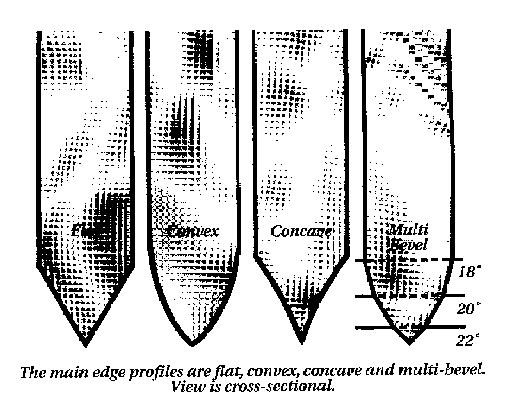
This variation will give you a longer
lasting edge than the conventional method described above. The multi-bevel
edge that results is similar to the convex edge found on Moran and
BlackJack knives and the Trizor edge on Chef'sChoice knives. This method
can be adapted to many types of sharpening equipment.
The first step is to grind an initial
edge bevel about 5 degrees less than you want your final angle. This is
sometimes referred to as pre-sharpening or thinning the blade. You will
put a little more work into this step, but you will save some work later.
Grind until the old edge is removed. As described above, the proof is that
you have raised a burr.
Now change to a medium stone and set
your guide for a few degrees greater angle. On a clamp-on type guide you
increase the angle by moving the guide closer to the edge. On a rod type
systems you can easily select another angle. Other systems have different
ways to adjust the angle. See the section below for a method using the
Lansky sharpener.
When you get to the fine stone
increase the angle again another couple of degrees. Hone with strokes
going onto the edge and alternate sides with every stroke. You are now
grinding only a small area right at the edge, removing the burr and the
scratches from the medium stone.
Since a finer stone cuts more slowly,
it usually takes quite a bit of work to remove the previous step's
scratches. By increasing the angle by a couple of degrees when you change
stones, you focus this work on a smaller area near the edge and reduce the
work needed
MULTI-BEVEL
WITH A LANSKY SHARPENER

A multi-bevel edge can be accomplished with a Lansky Sharpener
by fixing the rod at different positions with each stone.
Here is an easy way to do a
multi-bevel with the Lansky:
1. Push the rod into the coarse stone
as far as it will go and still have the screw tighten against the flat.
This decreases the angle by a degree or so. Do extra-coarse stones the
same if used.
2. Mount the rod on the medium stones
in the center of the flat per the instructions.
3. Push the rod into the fine stone
only far enough to tighten the screw against the flat. This increases the
angle by a degree or so. Do the ultra-fine the same if you have one.
Now, when using these stones you will
automatically create a three bevel edge.
Tip: replacing the thumb
screws with flat head screws will give you another 1/2 inch or so of
useful stone.
HONING
You can further improve the edge by
honing the edge on an ultra fine Japanese, Arkansas or ceramic stone, 1000
grit or better. Maintain the same angle as the final step above.
USING
OILS AND WATER ON STONES
In North America we usually use oil
on sharpening stones; in the rest of the world they use water. Tests by
John Juranitch show that because oil carries the dross against the edge,
better results are obtained with a dry stone. However, natural stones tend
to clog without oil. I prefer ceramic and diamond stones used dry,
and my second choice is Japanese waterstones.
I'll leave this up to your personal
preference, with the following guidance. With India and bonded Arkansas
stones you can use oil or use them dry. Clean them with paint thinner. Use
and clean Japanese waterstones only with water, but store them dry and
soak them before using. Ceramic and diamond stones can be used dry or with
water. Clean them with water and scouring powder when necessary. Washita
and natural Arkansas stones can be used with oil, water or dry, and
cleaned accordingly.
If you have used water on a stone and
want to change to oil, let it dry thoroughly, and then oil it. Once you
have used oil on a stone, it is difficult to change back.
Company and product names are trademarks of their companies.
| Home | | Contact |
| About Us |
| LINKS | |Suppliers |
| Photos |
| Sharpening
Schools |
Copyright 1996 - 2026 by Steve Bottorff